Melody Neel: Guest Blogger "A First Aid Kit For My Chickens"
Dear chicken keeper,
I have to admit, when I was asked to write this blog, I was both overwhelmed and honored. Then my medical side kicked in, and just like on my Facebook page, Chicken Addiction Anonymous, I knew people needed help on how to take care of healthcare issues.
Why A First Aid Kit Matters
You know, anyone who keeps chickens long enough learns one simple truth: flock emergencies don’t wait for a convenient time. Whether it be a rooster scuffle at dusk, a hen caught in wire fencing, a sudden limp, a chick with a pasty butt, these things happen in every flock, whether you keep 3 backyard hens or 300 heritage show birds, and at any time, especially when the supply store is closed. Ha! A well-stocked chicken first aid kit turns panic into a plan. It saves time, saves money, and most importantly, can save a bird’s life.
Who I Am
Before I get further into this, perhaps I should introduce myself. I am the chicken-obsessed woman behind the Facebook page Chicken Addiction Anonymous, which provides an online humor and educational community, with a farm (The Crazy Chickens’ Farm) of over 100 birds with 32 different breeds. I am also a chicken breeder, and in my spare time, I work full-time as a medical provider for the US Air Force.
Why I Care So Deeply About Chicken Health
What I am not is a Veterinarian. I practice animal husbandry. A lost art, in my opinion. But being a medical provider is why I got interested in the best way to take care of medical issues with chickens. I scoured the internet, I have access to the Veterinary Merck Manual, have inquired to other chicken owners and breeders, and I have a family relative who’s a Veterinarian.
I wanted to find the very best way I could to practice animal husbandry with my flock. And then I wanted to help others. So here I am doing that very thing which I am very passionate about. I want people to feel confident, prepared, and capable when their flock needs them. Whether you are brand new to chickens or knee deep in chicken math already…I’ve got you.
How This Chicken First Aid System Was Built
Like most chicken owners, I learned quickly that having the right supplies on hand can turn a stressful “oh no, what happened?!!” moment into something totally manageable. Over the years, through respiratory outbreaks, bumblefoot issues, sour crop, vent gleet, feather dramas, bullying hens, broodies, and more, I’ve built a first aid system that truly works in the real world.
In March 2025, I taught a chicken health care class open to the general public. At that time, my Facebook page Chicken Addiction Anonymous (CAA) had 3400 members. It now stands at 15.5k members in November 2025, with a total of some 25 people helping me with it. Without further ado, below is a complete, practical kit that covers most everyday injuries, emergencies, and the “just in case” moments every chicken keeper eventually faces.

A Quick Note:
After years of updating this list, I feel this is the bare minimum you should have on hand. But remember, this is MY list. It doesn’t have to be your list. It’s a suggestion to help you. Oh, and one word of warning, I do not subscribe to Apple cider vinegar use (very hard on poultry’s kidneys, especially in weather over 70 degrees F) or Diatomaceous Earth, as it needs to be applied carefully; excess airborne dust can be inhaled and cause respiratory issues in poultry. I keep my first aid kit in a rolling tool cart I got off of Facebook Marketplace. It works wonderfully.
➣ Nutra Drench
A vitamin supplement/nutritional boost. It gives a quick energy boost to listless birds.
Dosage: If the bird is not eating or drinking well, I use 0.5 ml given with a tuberculin (needleless) syringe (available at pharmacies) just inside the beak slowly twice a day. Or you can add 1 ml to a gallon of water and give it that way.
Change the water daily. There is no egg withdrawal with this product. Meaning eggs are safe to eat during treatment.
➣ Poultry Cell
This product is mostly B vitamins. And yes, you need both Nutra Drench and Poultry Cell. Poultry Cell helps in curing things such as wry neck, and it’s the best supplement for molting or birds that are ill. It is NOT meant for chicks less than 4 weeks of age. It is too thick for them to swallow, AND it has too high an iron content for their little bodies to tolerate and then cause major issues for them.
Dosage: 1 ml placed just inside the beak with a tuberculin (needleless) syringe and administered slowly, allowing them to swallow. Do this twice daily for 7 days. There is no egg withdrawal for this product. Also, this is the product you want to give FOLLOWING Corid (for coccidiosis) treatment, since thiamine is depleted with that treatment. You do not give at the same time; this is very important.
Dosage following Corid treatment is: 1 ml per 3 pounds of body weight given directly into the beak for 5 days. This is easier for weak or slow-to-bounce-back birds, and you can go past 5 days OR 1 teaspoon (5 ml) in 1 gallon of fresh water for 5 days if you are treating the entire flock.
➣ Rooster Booster B12
Yet another vitamin supplement for energy and appetite stimulation.
➣ Infant Ibuprofen
For pain. Give 0.1 ml per pound. No egg withdrawal. DO NOT USE TYLENOL (acetaminophen). IT CAN BE DEADLY TO POULTRY.
➣ Baby Aspirin
½ to 1 81 mg tab. For pain or suspected fever. Grind into 1 cup of water and administer to the individual bird slowly in a tuberculin syringe (needleless) IF they will NOT eat it on their own. Only give for 3-5 days. No egg withdrawal.
➣ Liquid Calcium
For egg-bound issues. Most feeds contain calcium nowadays, and you should be offering oyster shell in a side container 24-7, but liquid calcium may be needed for egg-bound issues. Dosage: 0.5 ml to 1 ml administered directly into the beak with a tuberculin syringe (needleless) and check the hen in an hour for the egg to have passed. For very large birds, you may need to do 1.5ml. In a pinch, you can grind up 2-3 Tums and place them in a teaspoon of plain Greek yogurt. This helps with the muscle contractions needed to pass the egg. A warm Epsom salt bath is also helpful during this time.
➣ Vetericyn
A great all-around wound cleaner, and it’s safe for chickens (whereas Blu-Kote is not and has a lifetime egg withdrawal). No egg withdrawal.
➣ Hibiclens (chlorhexidine)
Also, a wound product that is especially good for deep wounds or fly strike. Generally used ½ strength with water. For a fly strike, soak the body part in ½ strength chlorhexidine (with water) and use tweezers to get all maggots out of the wound. Make sure to even get any dead maggots or debris as left in they can cause a bacterial infection. For a deep wound, also use ½ strength as a flush (use a 5 ml or 10 ml needle-less syringe – available at pharmacies), then flush with normal saline (available at Walmart), then apply Neosporin (without pain relief), gauze, and wrap with vet wrap.
➣ Dewormers
It is generally recommended to deworm twice a year (yes, even if you have seen no worms. Chickens will eat/peck from the dirt where other bird droppings are, as well as bugs that carry worms.) It's also recommended to do this in Spring and early Fall, prior to the molt (if given while a chicken is molting, it can cause permanent feather damage). Additionally, rotate the type of dewormer you use.

It is also becoming common for chicken keepers to include a gentle herbal option in their rotation, such as WormStop – Natural Dewormer for Chickens. This all-natural blend supports a healthy gut while helping manage internal parasites, and because it requires no egg withdrawal, it offers an easy monthly approach for flocks that are actively laying.
Below are the four other ones used and their dosages. ALWAYS check the bottle to use, as directions may change. Remember, this is the preventative dosing. Should you have a specific infestation, dosing and type of dewormer may be very different. I highly recommend a fecal float test prior to any administration of a dewormer. These can be obtained from a local vet, or if you check my Facebook page, we have a “send off” source.
1. Safeguard Aquasol (fenbendazole) for chickens
(Bottle must have this exact phrase. There are many types of Safeguard.) Dosage: 1 mg per kg of body weight daily (which equates to approximately 0.454 mg per pound) for 5 consecutive days. Yes, you need to weigh the chickens. With this product, it is VERY important to measure accurately because overmedicating can be fatal. The product comes with its own syringe that is clearly marked. No egg withdrawal.
2. Valbazen (albendazole)
Given by mouth at 0.5 ml to standard-sized birds, to 0.25 ml to bantam breeds, to help eliminate tapeworms. Repeat dosage in 2 weeks. Fenbendazole or albendazole are the most effective and proven to eliminate flatworms. They also treat cecal worms, gapeworms, and roundworms. The majority of the other types of dewormers only treat roundworms. Because this is off-label, it is recommended to do a 30-day egg withdrawal.
3. Wazine (piperazine)
Used to be the go-to labeled dewormer for chickens, but it has become harder to find since the FDA pulled many of the over-the-counter medications for livestock. Dosage: 1 ounce (30 ml)Wazine 17% per gallon of drinking water. Wazine only kills large roundworms (Ascaridia galli). It does not treat tapeworms, cecal worms, or capillaria. Do NOT use in birds under 4 weeks old. Egg Withdrawal for 14 days.
4. Ivermectin
(pour on or injectable; Both are off-label). Covers roundworms, some mites, and lice; not effective for tapeworms. Dosage: injectable version: 0.1 ml per 2.2 pounds orally (yes, orally), repeat in 14 days. For the pour version: 1 drop per 2 pounds, place on the skin at the back of the neck, repeat in 14 days.NOT recommended for use: Ivermectin Horse paste, as it can easily be overdosed. 14 Day egg withdrawal for any use of Ivermectin.

➣ Terramycin eye ointment
Used for infections or corneal abrasions. Dosage: Place a little sliver in the eye twice daily for 10 days. No egg withdrawal.
➣ Elector PSP
For mites and lice. Be aware that the 8-ounce bottle is $160-$180, but you only need 9-10 ml and can obtain that size dosage from several sources that are listed on the CAA page, or The Chicken Chick has it on her website. Dosage: 1 drop under each wing for ALL birds, then mix 9 ml in 1 gal of water and spray birds around the vent. Do not saturate. Spray the coop and nesting boxes after first removing all bedding and burning it. The dose is only good for 24 hours once mixed with water. May need to repeat in 1 week if severe infestation, but generally one treatment is all that is needed. Results can continue killing bugs up to two weeks and kill eggs. No egg withdrawal.
➣ Neosporin
(WITHOUT pain relief in it) ointment to help heal wounds and abrasions.
➣ Normal Saline
A wound flush is available at Walmart.
➣ Manuka Honey
It can be used in wound care as well as mixed with egg yolk to provide energy/recovery from wounds/traumatic events.
➣ Arnica gel
For topical use on bruises/beak injuries.
➣ Styptic powder or corn starch
Use to stop bleeding on nails/non-wound areas
➣ Prid
Available at Walmart or on Amazon. This is a miracle drawing salve. Used for bumblefoot and prevents you from cutting into a highly infectious Staphylococcus aureus infection. How to use: ISOLATE THE BIRD FROM THE FLOCK, then soak the foot in a warm Epsom salt bath for 30 minutes to allow for cleaning and softening of the foot area. Dry. Wear gloves at this point: apply prid to the bumblefoot area. Cover with gauze. Wrap with coban or vet wrap. Change the dressing daily (no need to soak). You may be doing this dressing change for as long as 3 weeks.
The bumblefoot will rise from the foot or completely come out. Or you may gently scrape your gloved nail against it to see if it lifts out. Again, the importance of wearing gloves with this procedure cannot be overstated. When it is out, if there is a hole left in its place, apply Neosporin (remember to use the one without pain relief) or manuka honey, cover with gauze, and wrap until the hole is no longer evident. Once that is closed, no more dressings are required, and the bird may rejoin the flock at night. WARNING: No matter what others say, DO NOT try to cut this out.
➣ TiaGard
Available on Amazon. First line for simple respiratory infections. Dosing: 3 teaspoons per gallon of water daily for 14 days, making a fresh solution daily. A preventative dosage is 1.5 teaspoons in 1 gal of water, 3-5 days consecutively every month. Again, a fresh solution daily. It needs to be the only drinking source, and it tastes really bitter to the bird. It is recommended to add apple juice to some of the water or add ¾-1 cup of sugar. Generally, you will not see good results until day 10. Do not stop treatment before day 10. There is no egg withdrawal with this product.
➣ Acidified Copper Sulfate
Many positive uses. It can sanitize waterers, which you should do weekly either with this product or Oxine. It is extremely helpful for sour crop. Dosage for sour crop: Isolate the bird. First, flush your chicken with an Epsom salt solution of 1 teaspoon plain Epsom salt in half a cup of water. Gently syringe in 5 ml of solution down the bird's throat twice a day for 2-3 days, being very careful not to get it in the bird’s airway.
Then, ½ pound acidified copper sulfate and ½ cup white vinegar into ½ gal water, do not use a metal container. This will be your stock solution. Put 1 tablespoon in 1 gal of water for your chicken’s water, again, not in a metal waterer. Do this until your chicken is better. During this time, a probiotic like plain yogurt is very beneficial for the bird. For vent gleet: ¼ teaspoon of acidified copper sulfate per 1 gal of water. Provide as the only drinking water for 3-5 days. This can be repeated once a month if needed, but not for long-term use. Can buy acidified copper sulfate from places like Stromberg’s chickens or JEDD’s Bird Supplies.
➣ Epsom Salts
Plain. To soak during eggbound issues or bumblefoot. Can also be used for sour crop: Dosing: mix 1 teaspoon plain Epsom salts in a half cup of water. Gently syringe 5 ml down the bird’s throat twice a day for 2-3 days, being careful not to get into the airway. Another use for Epsom Salts is as a poultice to help cure Bumblefoot. It’s slightly less caustic than Prid. You simply put a tiny glob of Epsom salts mixed with a tiny amount of water to form a small glob, put it over the Bumble, add gauze, and then wrap with Vetwrap or Coban. Change dressing daily.

➣ Monistat
(yes, the kind for vaginal yeast infections). Definitely off-label. But has shown success for sour crop and vent gleet treatments. (Alternatively, acidified copper sulfate may be a better product to use for sour crop.) Dosage: cut a suppository pellet into pea-size bites and feed one piece (with bread wrapped around it) to the chicken twice daily for 7 days (gently open beak and place in mouth – it may end up being around 4 small bites to get the pea-size bite eaten). 1 week egg withdrawal with this product.
You can also give 0.25 cc Monistat cream orally twice daily for 7 days. This does not work for an impacted crop. The cream can also be used on the inflamed vent area after it is gently cleansed with baby shampoo. Another option would be to topically clean the vent with warm water or diluted chlorhexidine solution. Blot dry and can apply manuka honey (which is a natural antibiotic, antifungal, and antioxidant that heals things like vent infection in about ¼ of the time it normally takes) or an emollient like Eucerin.
➣ Oxine
Food-safe sanitizing disinfectant is safe for birds and animals as well as people. Food and water containers need to be washed and sanitized on a weekly basis to keep illnesses from happening/progressing. It is available on Amazon, but I find it cheaper at Cheshirehorse.com. I put some in a spray bottle, and after washing and rinsing, I spray this all inside the container. Also, 1/8 teaspoon Oxine to 1 gallon of water can be placed in the waterer to keep the biofilm (slime) down and help to reduce the risk of respiratory issues. One of my favorite product finds.
➣ Tylosin (Tylan)
Available at Jedd’s Bird Supplies. I think it’s always a good idea to have either this or Doxy-Tyl, which is a combination antibiotic, in your pocket. However, I do not encourage use unless you are sure you need to use it, generally, for a respiratory infection where the 14-day treatment of Tiagard was ineffective. Poultry DVM states no egg withdrawal.
➣ Corid
I do not think this is necessary to keep in your First Aid kit until you need it, and that is when coccidiosis is verified. Easily obtained at feed stores. Rarely needed. Alternatively, there is also a product called Toltrazuril that can be obtained, which works for coccidiosis. It is not normally found in feed stores.
➣ Electrolytes
There is nothing magical or mysterious about electrolyte solutions you purchase at the store, and you can easily make your own! Here’s the recipe:
- 1 cup warm water
- 2 teaspoons sugar
- 1/8 teaspoon salt
- 1/8 teaspoon baking soda
- 1/8 teaspoon potassium chloride (optional) – this is a table salt you can pick up at any grocery store. It’s not strictly necessary in a pinch, but the potassium is nice to include if you happen to have some.
For longer stretches of heat, stress recovery, or flock-wide hydration support, use AquaBoost, a blend of vitamins, probiotics, and ginger that offers a convenient, ready-made option when birds need more than basic electrolytes.
➣ VetRx
I did hesitate to add this. It is not a cure for anything. It is simply a supportive care for a respiratory illness, very similar to Vicks VapoRub for humans. Dosage: Place 2-3 drops under wings and on the beak and wattles with a Q-tip. No withdrawal.

Other non-medication items you need:
- Food scale
- Syringes (TB size, 3 ml, 5 ml, 10 ml)
- Long tweezers
- 2x2 gauze
- Vet wrap or Coban
- Safety glasses (for wound care)
- Small dog crate for isolation
- Gloves
- Eye dropper
- Digital thermometer (a chicken’s temperature should be between 105–107°F)
- Measuring spoons
- Cat or dog nail clippers
- Chicken support bag (A bag you hang from a doorknob or similar setup to work on the chicken’s feet solo; very helpful and available on Amazon)
- Baby shampoo
- Dawn dishwashing liquid
- Bag balm, coconut oil, or Eucerin cream
- Antifungal ointment
- First Saturday Lime (different from barn lime)
- Good strong flashlight
- Headlamp
- Small plastic tub
- Scissors
- Q-tips
This is the end of my list. But I did include Holistic First Aid Kit instructions from my good friend Taryn Gibson.
Herbal & Natural Remedies
- Oregano Oil – natural antibiotic/antifungal (dilute before use)
- Garlic (raw or powder) – immune and parasite support (occasional use in feed or water)
- Chamomile tea – Calms and soothes, great for stress or wounds
- Calendula salve or dried petals – healing and antifungal
- Plantain (dried or fresh) – soothes bites, stings, and wounds
- Goldenseal powder or tincture – Antibacterial for wounds
- Echinacea tincture – immune support during illness
- Ginger tea or powder – Anti-inflammatory and digestive support
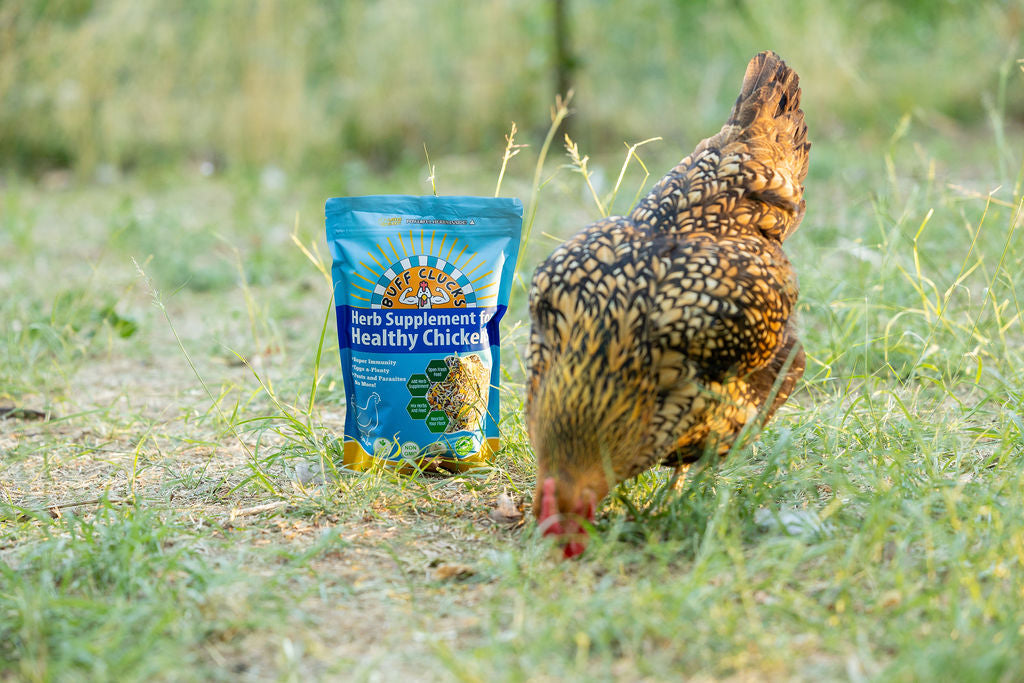
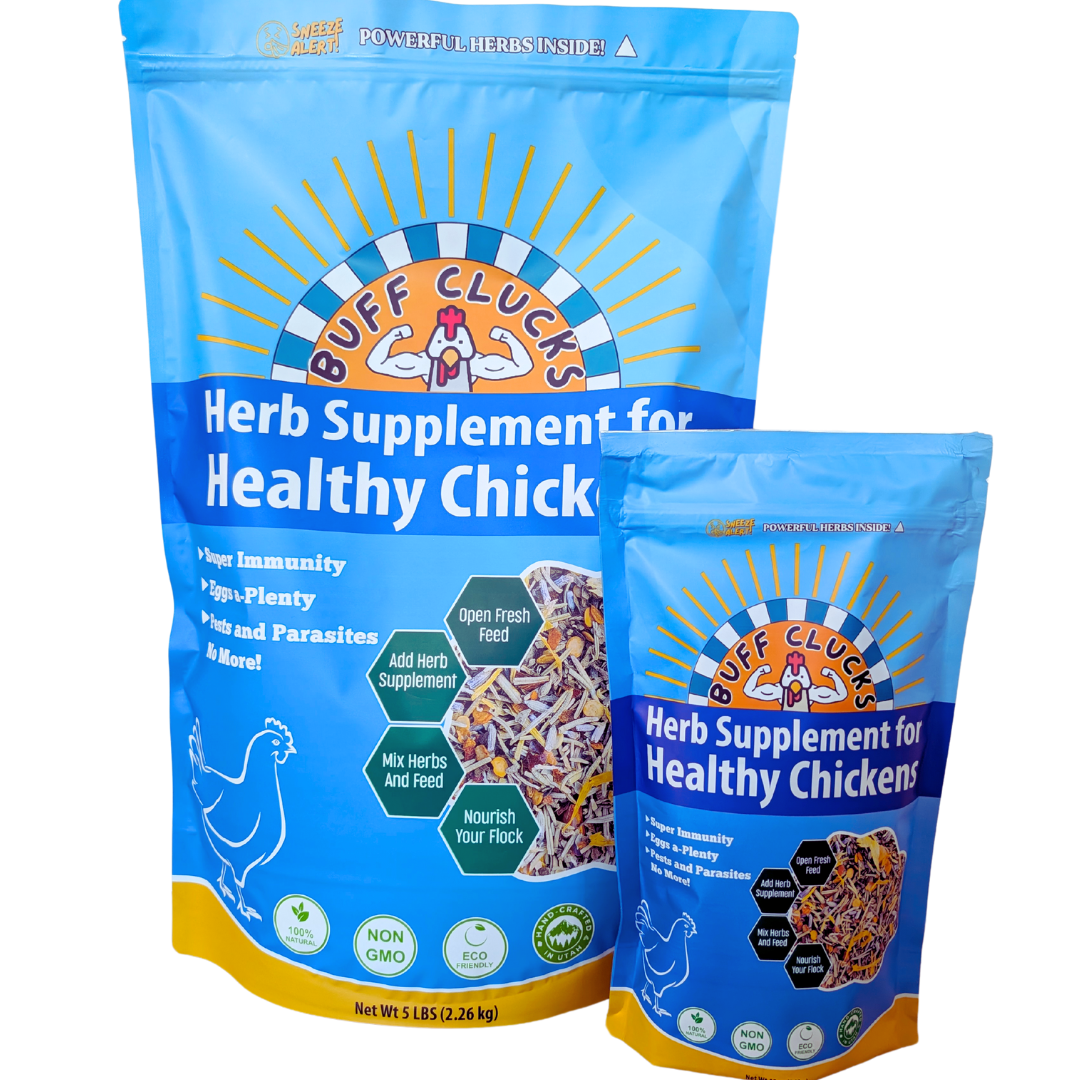
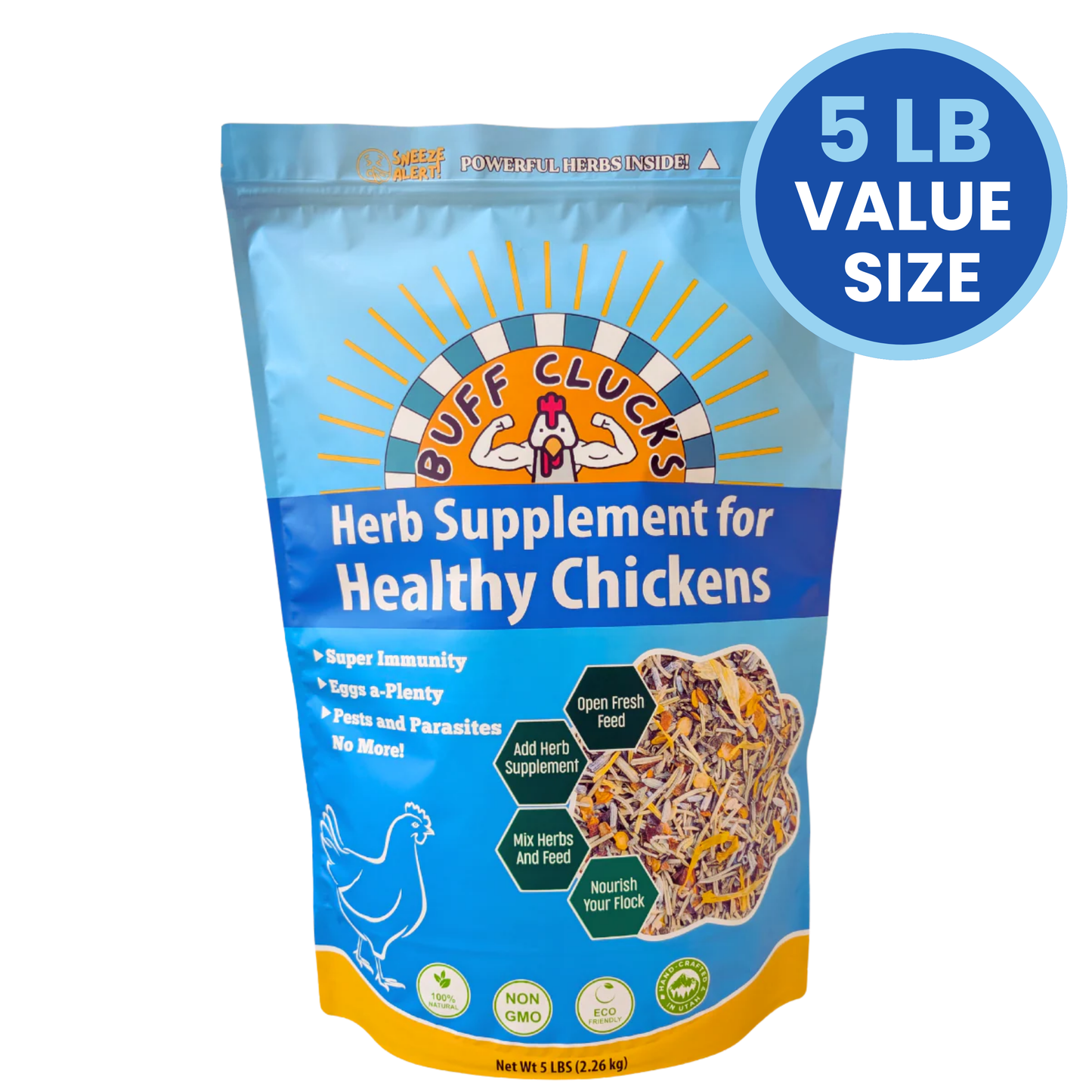
A simple way to round out a herbal remedy is to keep Buff Clucks Herb Supplement on hand for everyday support. It combines oregano, garlic, rosemary, basil, lavender, red pepper flakes, and calendula into one easy daily boost. It’s an effortless way to keep your flock resilient long before emergencies happen.
Herbs to keep on hand:
- Chamomile (calming, digestive support)
- Peppermint (respiratory and digestive)
- Thyme (antimicrobial, respiratory)
- Echinacea (immune support)
- Yarrow (wound healing and clotting)
- Marshmallow root (soothes crop and digestive issues)
- Slippery elm bark (crop and gut health)
Topical & Skin Healing:
- Tallow Wattle & Comb Guard – protects comb, wattles, and feet from frostbite, dryness, and cracking
- Cluckin Clean shampoo – safe for bathing chickens with pasty butt, vent care, or dirty feathers
- Manuka or raw honey – Natural antibacterial wound salve
- Wormwood, Black Walnut, Clove, Garlic tincture – dewormer
- Witch Hazel – cleans wounds and reduces swelling (alcohol free)
Internal Support:
- Colloidal Silver – antibacterial (use sparingly for infections or fungal)
- Activated charcoal – use in poisoning/toxin emergencies
- Probiotics – especially after antibiotics or deworming (fermented feed works great also)
- Epsom salt – for foot soaks, egg binding, or detox baths
Minerals & Balance:
- Baking soda – For crop issues and pH balancing (tiny pinch in water, short term only)
- Sea Salt/Redmond’s salt – mineral support and hydration (occasional 2-3 x week)
- Molasses or Honey – For birds in shock or after blood loss (1 tsp in water maximum)
Optional Stress/Trauma Support:
- Rescue Remedy (per version) helps during shock or high stress
- Lavender oil – calms nervous birds (diffuse or dab in coop or nesting box, never on the bird directly)
Final Note: Do not let this list overwhelm you. I tried to include EVERYTHING I could think of that you might possibly need. You can get these things a few times each month.
The medications mentioned (TiaGard, etc.) I do highly recommend it be one of your first purchases.
Wishing you success with your flock,
Melody